
It can be difficult to describe what strategy consultants do in terms that are relatable to people in the real world, say, at a dinner party. Often, projects are specific to organization’s domains and their particular challenges within those. challenges within those domains. Of course it helps to avoid any kind of jargon (or worse: consulting-lingo) and focus on how we make a difference. But can get abstract, like, oh. we’re working on a plan to make the treasury auction system for the Federal Reserve Bank more resilient. Eyes gloss over. Unless you found someone who loves rabbit holes.
But once in a while you land on something where the vocabulary doesn’t matter because the thing itself matters to everyone in the room. One example was a project we worked on to redesigned how Los Angeles County votes. Now the reaction is completely different. Everyone votes. Everyone has opinions about voting. Suddenly you have a dinner conversation.
What We Were Trying to Do
Voting in my county, which has a larger population than all but 4 states, used to be an old-school affair. If you voted in person, you’d go to your assigned precinct where polling staff looked you up on a printed list on green bar paper and strike your name. You’d get a ballot that looked like a 1960’s punch card to ink your choices in a series of bubbles, with an overlay to show where to mark for which choice. Vote by mail was worse, because there was no overlay. It worked, but from the voter’s perspective, it was cumbersome.
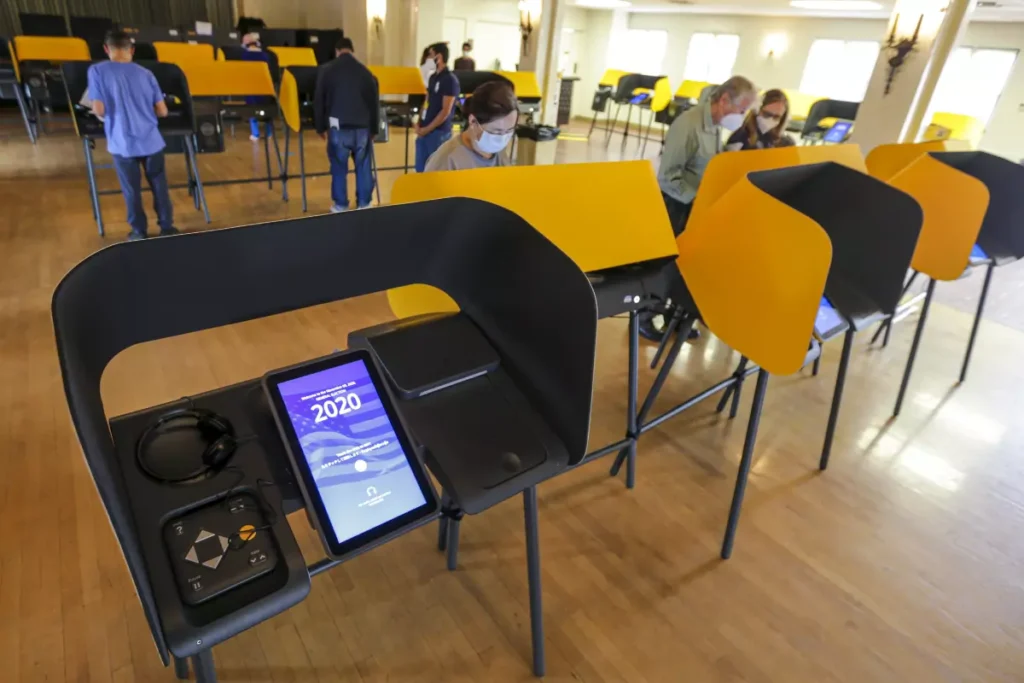
To its credit, county leadership recognized they could do way better. Their aspiration was to reimagine the entire voting experience from the ground up. User friendly ballot marking devices, a vote-by-mail experience with ballots you could actually read, a tally system built on publicly-owned open source technology, and a fundamental shift from assigned neighborhood precincts to vote centers where you could cast your ballot anywhere in the county. The experience design was led by a renowned human centered design firm, working alongside the county’s own inspiring teams and informed by years of community and expert input. They crafted an ambitious vision for what voting in LA County should feel like and called it Voting Solutions for All People (VSAP).
I came in when the ideas needed to become buildable. We took the design vision and translated it into architecture, end-to-end flows, and requirements that an implementation partner could scope and bid against. It’s a balancing act. Write the ask too tightly and you end up with a vendor executing compliance rather than contributing expertise. Write it too loosely and they build what’s familiar to them instead of what serves the voter. The architecture had to hold a clear direction with room to breathe.
The Calendar Doesn’t Care
There are deadlines and there are elections deadlines. You can’t negotiated them, push ’em out for a quarter or reconsider them in the next steering committee. The new experience, solution, processes, and people better be ready or the fallback plan is eating crow. That knowledge sits in the back of your mind on a project like this and it changes the way you make every decision. You cut scope differently when the consequence of delay isn’t a missed market window but voter disenfranchisement.
After the implementation partner, an innovative and highly capable international election technology firm, was selected, the work shifted into risk management across the full program, and no less exciting. For example, the shift to vote centers meant voters could walk into any center in the county, which meant the mechanism to track who already voted needed to synchronize with every other vote location in the state to prevent someone from voting at two locations. That turned out to be remarkably challenging at this scale. There were other challenges of the non-digital kind you might not expect. Ballot devices for in-person voting are air-gapped by law, meaning they can’t be connected a network or worse, the internet. So there’s a logistical challenge of configuring 30,000 machines for a specific election, with lots of local variations for school board districts and what not, and getting them securely to hundreds of vote centers.
There were many parties watching with many different interests. Voting rights advocates, disability rights organizations, political parties, county supervisors, the Secretary of State’s office, media with varying degrees of technical sophistication. The fishbowl changes how you communicate. You learn to be precise in what you claim and transparent about what you don’t know yet, because the stakes are high for spin and someone is always listening.
The system went live for the March 2020 presidential primary. Days later the world shut down for COVID. The team had worked for years to get to that moment and the moment itself was immediately swallowed by a crisis that nobody saw coming. The primary happened, the system worked, then everything else stopped.
Losing Kenneth
I want to talk about Kenneth Bennett because what he built is part of how millions of people vote and because working with him shaped how I think about public sector technology.
Kenneth was VSAP’s program manager and its technical conscience. He had been working on elections technology since 2004, long before VSAP existed as a concept, and drove the notion that the county should own its voting system’s source code outright, built on open, non-proprietary technology, so that the public’s voting infrastructure belonged to the public. That was a genuinely radical idea in the election technology industry. He championed it in front of standards bodies, testified about it, and built the foundation that made it real.
He was brilliant and he deeply cared why this work mattered for democracy. He was such an inspiration and I was proud to be his thought partner in some of the hairy aspects of this adventure. More importantly he was a friend. We lost Kenneth during the program. I don’t want to dress that up with language about how the team adapted and carried on. It hurt. The work continued because the work had to continue, but his absence was felt by everyone who relied on his judgment and his conviction that what we were building was worth building well.
One More Thought
I’ve worked on a lot of projects that mattered to the organizations they served. This one mattered to everyone who votes. It was tangible and the stakes were real in a way that is easy to recognize. That doesn’t happen often in this line of work, and when it does, you hold onto it.
Go vote in the next election.
